Currently, PRP injection for knee pain is being actively explored in clinical trials as a potential definitive form of pain management for knee osteoarthritis. Although the FDA has approved certain forms of PRP for specific purposes, none have received specific approval for use in knee osteoarthritis. Thus, the administrators of other interested clinics might be marketing PRP as a treatment.
PRP treatment should only be provided when research sheds more light on its efficacy and helps establish standard protocols for its use, experts say. This, of course, means that no one knows exactly what is even in your dose.
In a Hurry? Dial 312-374-3352 now!
How Does PRP Work?
Let’s not be pessimistic. If PRP were accepted as a legitimate treatment for therapy on knee osteoarthritis, proof would surely come after yet another round of studies that would uphold its validation. So, what is PRP, A piece of machinery to the subject?
PRP therapy for the arthritic knee involves injection therapy by attempting to avoid damaging tissue by injecting platelet-rich blood into the tissue around the knee. Blood consists of a liquid substance (plasma) and three types of solid cellular components: platelets, white blood cells, and red blood cells. In the process of blood clotting, platelets come into play in the coagulation event, but they also contain special growth factors that can be activated to possibly generate new cells.
What Are the Proposed Benefits of PRP Injection for Knee Pain Toward Knee Osteoarthritis?
Some studies showing that it helps with knee osteoarthritis are:
Of 153 subjects, one evaluation by a 2022 article reported improvements in pain and stiffness, mobility and functional ability, and quality of life overall at 6 months after PRP treatment.
A 2021 study of 118 participants said PRP would improve knee osteoarthritis symptoms after about 51.7 months of follow-up.
PRP was more effective than steroid injections and hyaluronic injections, and placebo at 3, 6, and 12-month follow-up, according to a 2020 review article. A 2017 review found that PRP showed effects better than placebo counterparts in reducing pain and improving function in follow-ups at 3, 6, and 12 months.
Some of the views contradicted other studies, which stated that PRP therapies for knee osteoarthritis were weakly assessed. Some studies supported PRP injection for knee pain, while others condemned it as ineffective. In fact, there is more room for further studies to investigate whether PRP indeed shows efficacy and safety in treating knee osteoarthritis.
What’s the Risk of PRP for the Treatment of Knee Osteoarthritis?
The risks of PRP do not exceed those related to standard treatments for knee osteoarthritis.
Well, injections into the knee joint come with some risks, such as:
- local infection
- pain
- nerve injury arising during the procedure
Documented side effects include:
- pain
- stiffness
- tachycardia
- loss of consciousness
- dizziness
- nausea and vomiting
- profuse sweating
- headaches
PRP treatments tend to be very expensive with regard to knee osteoarthritis treatment, and there is likely to be several of these over time.
Oh, and don’t forget to talk to your doctor about PRP, what it costs, and potential side effects; they will be able to help you weigh it against the other options available.
In a Hurry? Dial 312-374-3352 now!
What Happens During the Procedure?
In a nutshell, there are 3 main processes involved:
- Draw a small amount of blood from your arm into a syringe. The blood sample is then subjected to the process of centrifugation to separate its various elements and yield a concentrated suspension of platelets in plasma.
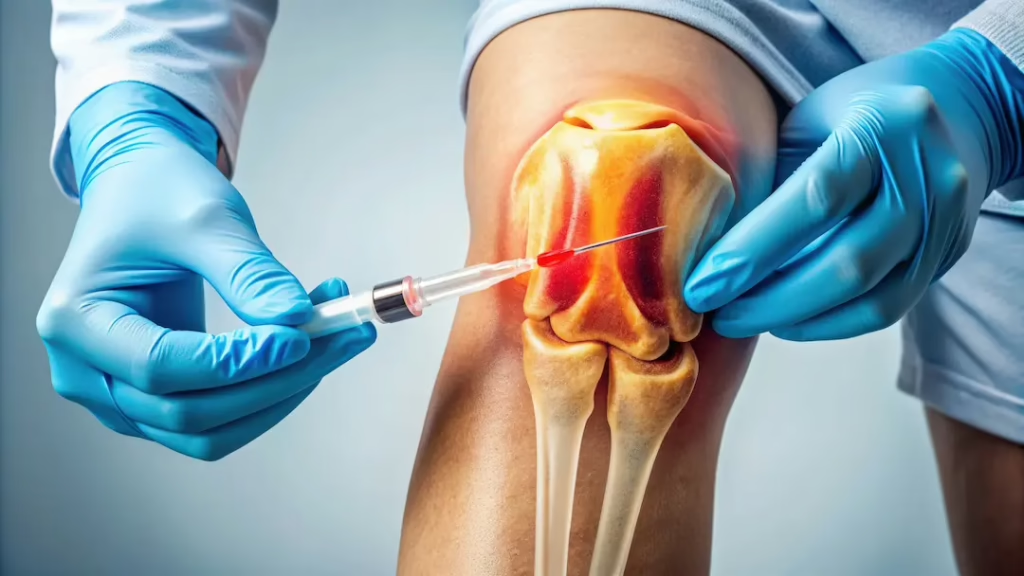
- Injected by the doctor into the knee joint space after numbing with local anesthesia. Ultrasound may be used to guide the injection.
- You will be resting for a while and will be free to go home. Make sure you have someone to drive you home, as you will most likely experience some pain and stiffness following the injection.
What Should a Patient Know About Recovery From the Operation?
Typical post-PRP instructions include:
- Ice your knee for 20 minutes every 2-3 hours for the first 3 days.
- Over-the-counter pain medications will alleviate discomfort.
- Avoid NSAIDs as they could inhibit the effectiveness of PRP.
- Rest up and avoid putting any weight on your knee.
- It would be helpful to use crutches or a knee-walking assist for a couple of days to relieve any weight on the joint.
- Follow the doctor’s orders for follow-ups.
Frequently Asked Questions About PRP Injection for Knee Pain
1. Does PRP Have a Positive Effect on Arthritic Cells?
PRP therapy might work better than perhaps many other treatments for knee osteoarthritis, although efficacy might still be murkier long term, needing more studies.
2. What Is the Success of PRP in Treating Knee Arthritis?
As reported in a study published in 2021, the PRP response rate was 60%, necessitating multiple injections to treat knee osteoarthritis.
3. How Long Do PRP Injections Last in the Knee?
PRP local injections for knee osteoarthritis, and research currently does not agree with each other on the duration of the benefits produced. The studies suggest that it can maintain relief conditions for 12 months after injection; however, one study found this to be nonexistent after 24 months.
4. Can PRP Regenerate Cartilage in the Knee?
PRP alleviates the symptoms induced by knee osteoarthritis; however, imaging studies show that it does not really regenerate cartilage.
Final Thought!
Knee pain PRP injection shows some hopeful evidence in alleviating the pain of knee osteoarthritis, but more studies need to be conducted to determine its legitimacy over a long period. It should be used with caution, as there is presently no consensus on the standardization of preparation procedures.
If this treatment is under your consideration, consult with your physician for appropriate guidance and evaluation. Otherwise, please remember that PRP injection for knee pain remains an experimental therapy offered at certain specialized clinics using an off-label application.

Are You Looking for Experts?
Here at Dvida Med Spa, our medical professionals offer individualized consultations to guide you through every option available. With cutting-edge technology, highly-skilled staff, and a patient-focused approach, we ensure that you make well-informed choices when it comes to your health and recovery. Book your consultation today, and find out whether a PRP injection for knee pain is right for you.
Take the opportunity of booking your consultation today to discuss your wishes, know the latest information about PRP injections, and how this may help you. Start taking baby steps toward regaining mobility and comfort; contact Dvida Med Spa in Cary, NC, or Chicago now so our specialists can begin a personalized care plan designed just for you.